

From counter-steer to rear drive, how RC drift switched to RWD
In 2014 the realistic way to drift a 1/10 car was an all-wheel-drive chassis with its rear axle overdriven. Today's rulebooks ask for rear-wheel drive. Here is what changed on the car.
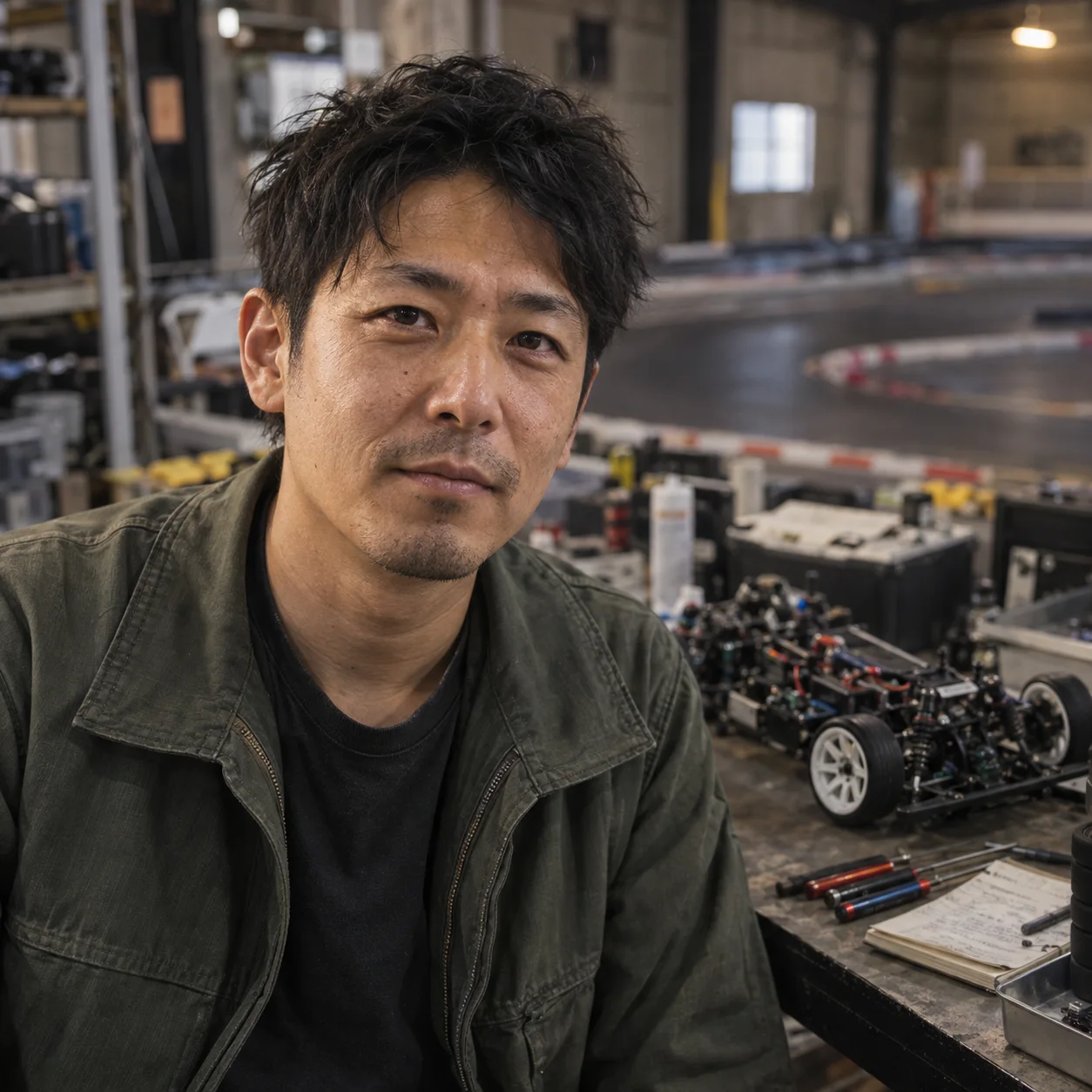 Daichi Morita읽는 데 8분
In January 2014 the RE-Xtreme RC blog posted a history of the hobby it called the Drift Bible, and one sentence in it (revised in 2016) sums up where the scene stood: "Until recently 2014 FCD or CS drift was the norm and created a huge following." FCD and CS are two names for the same thing: an all-wheel-drive chassis geared so its rear axle is overdriven.
Twelve years later, the rules for the Super Drift Competition, a US series with 31 regional hosts listed this season, settle the drivetrain in one line: "All chassis must be 1:10 Scale, Rear Wheel Drive." Between those two sentences, the front half of the drivetrain came out of the car and a gyro went in between the receiver and the steering servo. The sources below show how that happened, and what it changed on the chassis.
Three drivetrains, in the order the scene tried them
Big Squid RC's January 2015 primer, "Drift Itch – The Evolution of the RC drift chassis", is the clearest map of the generations, and RE-Xtreme's history fills in the names.
- 50/50 AWD. Front and rear turn at the same speed. Big Squid called it "the recommended setup for beginners because the car is docile and forgiving", with long slides that are "very prone to understeer (push)". It was also the cheapest way in: most RTR drift cars on shop shelves, such as the HPI Sprint and Tamiya TT01D, were built this way. RE-Xtreme remembers Yokomo's early Drift Package, released "with links to D1 sponsors", as the moment "the cars and look became quite realistic. Except for the 50:50 4 wheel driving style."
- Counter-steer (CS) AWD. Belt-drive owners found they could change the front-to-rear drive ratio by swapping pulleys. "In this setup the rear wheels spin much faster than the front effectively making the car more unstable, but much more agile in tight hairpin turns or on small tight tracks," Big Squid wrote, adding that most CS cars were belt-driven because pulleys are easy to swap. RE-Xtreme calls the Japanese version Full Counter-steer Drift, "FCD or KetsuKaki": a "rear wheel biased machine" with more steering angle ("Front steering up to 60 degrees is available") and one-way bearings in the drivetrain.
- RWD. Only the rear wheels are driven. Big Squid called it "the holy grail of drift realism" and said it "should be reserved for the experienced drift pilot only".
The CS ratio is the number people quote for how far the rear is overdriven. RE-Xtreme's author ran cars "from 1.5CS through to 4.5 and more" and wrote in May 2016 that "while around 2.5-3.5 seemed to give a realistic-ish feel, the driver is often compensating for the built in chassis imbalance." That last clause is the whole case for what came next.
Big Squid also noticed the naming problem: "How the heck the actual term for turning into a drift equates to an overdriven rear axle escapes me." In the scene's usage, CS describes a chassis's gearing, not something the driver does with the wheel on the transmitter.
What the gyro does, and why it was a fight
Take the front drive away and a 1/10 car on hard plastic tires wants to spin. Big Squid was blunt about it: "Without the use of a gyro (or D-box as they are often referred to) on the steering servo this would be purely an exercise in frustration for most drivers."
The gyro sits in the steering line. Futaba's manual for its GYD550, a gyro "designed to control steering for RC Drift cars", shows the layout. The receiver's steering channel goes into the gyro, the gyro drives the steering servo, and a separate input takes gain from a third channel on the transmitter, so the driver can change it from the radio. The unit has two modes, NORMAL and AVCS, and "In the AVCS mode, gyro control is firmer." The gyro senses the car rotating and adds counter-steer at the servo. Line, throttle and how much gain to dial in are still the driver's calls. Futaba's own product copy puts it as: "You tell the car where to go, don't let it control you!"
That was not how everyone saw it at first. RE-Xtreme, in 2014:
"Driving with a gyroscope that automatically steers the car to an extent has purists in disgust."
RE-Xtreme RC, Drift Bible, 2014
The same post notes that gyros were not new ("The HPI Drift Box has been out for a long long time but it was neglected as "auto pilot"") and argues that much of what a driver had learned on a CS car carried over only partly to rear drive.
2013 to 2017: when the entries turned
The shift is easiest to see in how the same sources describe the field from one year to the next.
- 2013–14. "2013 saw an increase in people adopting the Rear Wheel Drive RC chassis," RE-Xtreme wrote, but it was "still in R&D stage with only one manufacturers producing a complete chassis purely for RWD application. Two others make conversions." There was also "a lot of "spinning out" that still occurs in low speed corners."
- January 2015. Big Squid lists RWD as the third generation and notes that MST was selling cars in both 4WD and RWD form.
- April 2016. Red RC reported that Yokomo was about to release the YD-2, "specially designed for RWD drifting", with "an unique transmission and motor layout that reminds of 2WD mid motor dirt buggies with its high layshaft position", front suspension built for "the high steering angles needed for drifting", and room for standard or shorty LiPo packs.
- June to August 2016. Yokomo's own account, republished by the Super-G shop in 2018, says the team took three YD-2 prototypes to the D1-10-sponsored RC Drift World Championship in the Netherlands in June 2016, entered the RWD class for the first time and placed first, second and third, then released the YD-2 and YD-2 Plus at the end of August. Drift Mission's July 2016 post on the announcement listed approximate Japanese prices of ¥19,900 for the kit and ¥23,500 for the kit with a gyro: from launch, the gyro came in the box as an option.
- December 2016. At the first Scotland Xmas Cup, the prize stands were marked "RWD class", as the photograph at the top of this page shows.
- June 2017. Writing from the D1-10 World Championship in the Netherlands, Shapeways' blog counted "99 AWD (All Wheel Driver racers) from 22 countries and 163 RWD (Rear Wheel Driver racers) from 28 countries". By then, rear drive was the bigger class at the event the post called "the yearly happening for RC Drift enthusiasts".
When RE-Xtreme's author revised the Drift Bible in 2016, he added that rear-wheel drive "was not the death of RC drift".
What losing the front axle changed on the car
Taking out the front drive did more than change how the car initiates a drift. It freed the front end.
- Steering and knuckles. With no front axle to package, RE-Xtreme wrote in 2014, designers could make "many many low scrub radius knuckles", which keep "the wheel within the confines of the fender arch "like a real car" while previously in RC the wheel often disappeared behind the front fender." Big Squid put a number on the extra room: "The lack of front drive train can make for 80 plus degrees of steering angle."
- Weight distribution. On an RWD car, where the motor and battery sit becomes the main setup decision. Big Squid warned that "tire choice and weight bias have exaggerated effect on the handling". By May 2016 RE-Xtreme was listing the layouts on sale: "Front, mid & rear-motor variations. Mid and Rear Battery, Inline and Lateral." It is also why the YD-2 launch copy took care to say it would fit standard or shorty packs.
- The gyro became part of setup. Gain, mode and endpoints moved from "is it cheating?" to settings a driver changes for the surface, like springs or tires.
What the rulebooks say now
The rules for the Super Drift Competition (revision 10.5, dated September 16, 2026) show where the switch landed. Every car must be 1:10 scale and rear-wheel drive, run a 2S LiPo and a 6.5T–17.5T motor, have independent rear suspension, sit on a 240–275 mm wheelbase and run the spec tire handed out at the event. The series' home track, Super-G in Baldwin Park, California, lists "RWD 1/10 DRIFT CARS ONLY!" among its house rules. We profile Super-G and the series it runs separately.
AWD has not disappeared. The 99 AWD drivers at D1-10 in 2017 were a class of their own, and a 50/50 car was still being recommended to beginners in 2015 because it is forgiving and cheap. The decision now depends less on which drivetrain is "better" and more on where you will drive:
- If your local track or series is RWD-only, the choice is made for you. Read the track's rules, including its spec tire, before you buy anything.
- If you drive with friends on a mixed floor, RE-Xtreme's advice from 2014 still holds: "set your car similarly to your friends. They are the ones you will be drifting with."
- If you are coming from CS, expect the gyro to hold the counter-steer, and expect the setup work to move to weight distribution, steering geometry and gain.


Sources
- 1.
- 2.
- 3.
- 4.
- 5.
- 6.
- 7.
- 8.
- 9.
- 10.
- 11.
- 12.
- 13.


YAW 뉴스레터
첫 호 받아 보기
뉴스레터는 아직 발행 전입니다. 이메일을 남겨 주시면 첫 호가 준비되는 대로 보내 드립니다. 그 밖의 메일은 보내지 않으며, 주소를 공유하지 않습니다.
뉴스레터 안내이어서 읽기
YAW의 더 많은 이야기.

RC drift gyro setup: what the gyro does and how to set gain

How to start RC drifting: choosing your first 1/10 RWD drift car
