

DOSLOG’s RC ART video is a steering-feel checklist, not a blanket upgrade recipe
The new DOSLOG video frames a chassis conversion and knuckle-servo reinforcement parts around one setup question: how much of the steering-feel change comes from geometry, support parts and wheelbase choice? The useful answer is bounded by what the video confirms, and by what it leaves unstated.
 Daichi Morita6 minutes de lecture
Decision point
Start with the symptom: steering feel changed, but why?
DOSLOG’s new RC drift video is useful because it separates a handling claim into parts you can actually check: chassis roll-point changes, short and long wheelbase options, and reinforcement pieces for a knuckle-servo layout.
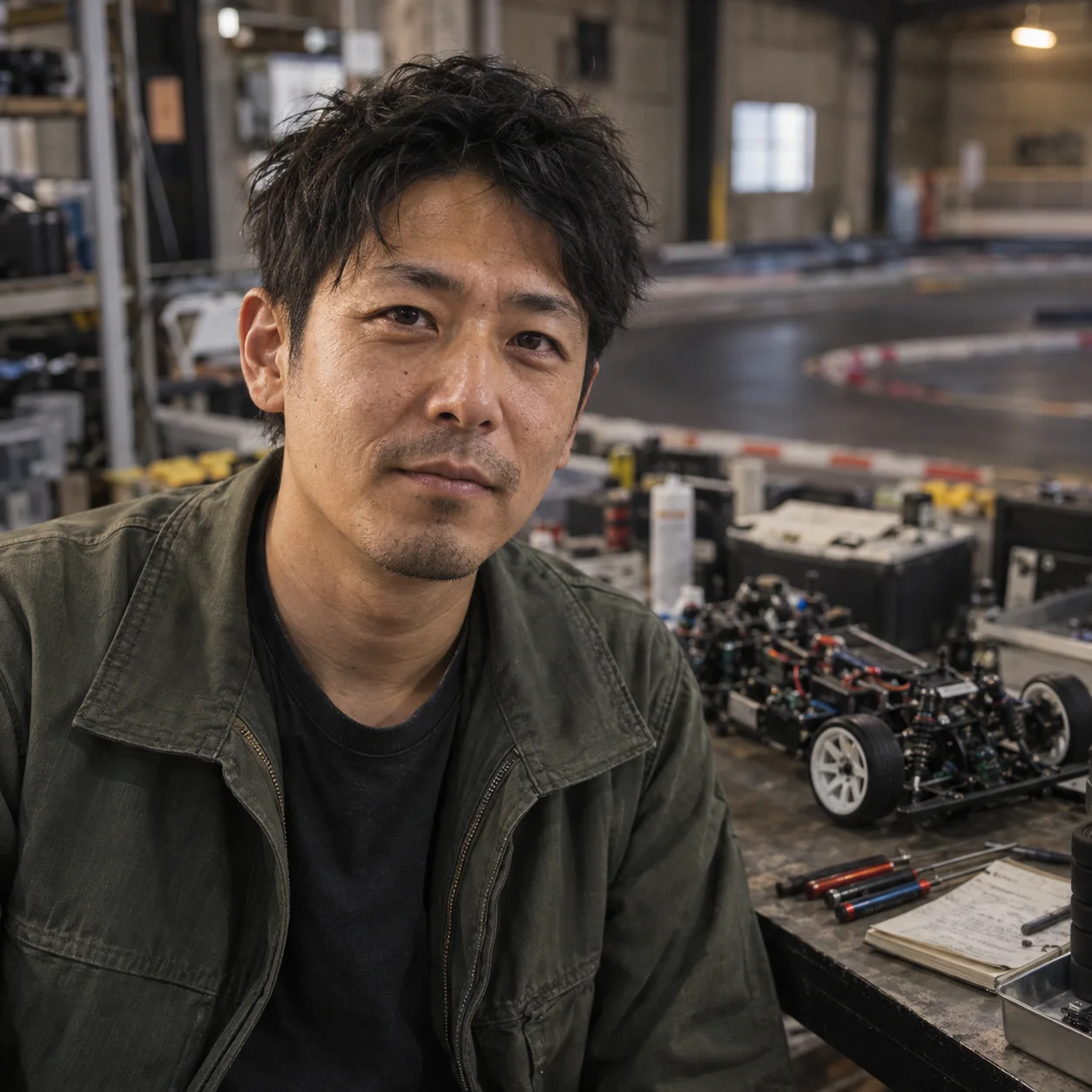
The video, ハンドリングが劇変する!最新シャーシとナックルサーボ強化パーツを徹底検証, was posted by DOSLOG on November 9, 2026. The supplied description says Takeshi, visiting from Okayama, explains the specification being put into use for GRK最強決定戦 2026. It also points readers to RC ART, but the supplied material does not give exact product names, prices, release status or a product-spec table.
That makes this a setup-reading piece rather than a buyer’s verdict. The video appears to address a common decision: if the front end feels inconsistent or the car is not responding the way the driver wants, should the first move be a chassis-side change, a wheelbase change, or support parts around the knuckle servo? DOSLOG’s chapter list gives enough structure to follow that order, but not enough to turn one reported specification into a universal setting.
Baseline
What DOSLOG confirms before the running scene
The confirmed baseline from the supplied source is compact:
- Media source: DOSLOG / doscaraskun, the RC Togo-linked YouTube channel from Aichi, Japan.
- Guest: Takeshi from Okayama, according to the description.
- Context: a specification for GRK最強決定戦 2026.
- Main parts discussed: a latest chassis or chassis conversion, plus knuckle-servo option parts.
- Chassis topics: revised roll point and easier short/long wheelbase changes.
- Front-end topics: an option plate for kingpin and trail adjustment, an integrated axle, and a dedicated capacitor.
- Track section: the video moves to running footage at 09:09.
The source does not confirm the scale, tire compound, track surface, gyro model, gyro gain, motor position, motor, ESC, battery placement, shock oil, springs, ride height or weight distribution in the supplied text. Those omissions matter. A steering part that helps one 1/10 RWD drift chassis on one surface with one plastic tire can feel different when the tire, surface and gyro response change.
Chassis side
Roll point and wheelbase are two different levers
The chassis-side headline is the revised roll point. The description does not publish the exact geometry, so the safe reading is functional: DOSLOG is pointing at a conversion that changes how the chassis supports roll, not only at a cosmetic or packaging update.
As a general RC drift setup principle, roll-point changes affect how load is transferred through the chassis when the car initiates, transitions and settles at angle. That does not automatically mean “more grip” or “faster steering.” On a hard plastic drift tire, especially on indoor surfaces, the driver is usually balancing front response, rear support and how quickly the car rotates without snapping. Without the surface and tire, the video can show a result, but it cannot define a universal roll-center recipe.
The second chassis lever is wheelbase. DOSLOG’s description specifically calls out the ease of changing between short and long specifications. That is useful because wheelbase changes are not the same problem as roll-point changes. A shorter wheelbase normally gives the driver a more eager rotation window; a longer wheelbase usually calms the car and stretches the transition. But those are general principles, not the documented setting for this car. The source only confirms that the short/long change is discussed as easier, and that it is tied into the knuckle-servo layout’s advantages.
Front end
The knuckle-servo parts target support and adjustment, not magic angle
The front-end portion is the more specific part of the video description. DOSLOG lists three items: an option plate for kingpin and trail adjustment, an integrated axle, and a dedicated capacitor.
Those are three separate setup ideas.
First, the option plate gives the driver another way to alter kingpin and trail. In RC drift steering geometry, that can change the relationship between the steering pivot, the tire contact patch and how the front end returns or loads during counter-steer. The source does not give the hole positions, dimensions or recommended settings, so the practical takeaway is not “run this number.” It is that the plate exists to move the geometry discussion away from a fixed knuckle-servo layout.
Second, the integrated axle is presented as part of the same weakness-reduction package. The supplied description does not state the material, weight or exact mechanical effect. Treat it as a reported support part until the product page or video detail is reviewed.
Third, the dedicated capacitor is listed in an effects-check segment. Since the source frames it around the knuckle-servo weakness, it should be read as an electronics support item for that steering arrangement, not as a motor-power upgrade and not as a gyro setting. The description does not publish voltage, capacitance or wiring detail.
Comparison
What to compare when watching the running section
The running footage starts after the explanation chapters, so the useful viewing method is to connect each behavior back to one adjustment category.
| If the car shows… | Compare it against… | Why it matters |
|---|---|---|
| A calmer transition | Wheelbase and roll-point changes | Those are chassis-side stability levers. |
| A more immediate front response | Kingpin/trail plate position | The plate is the confirmed steering-geometry adjustment. |
| Less inconsistency under steering load | Integrated axle and capacitor segments | Those are the confirmed reinforcement/support items. |
| A different return feel | Geometry plus gyro settings | The source does not publish gyro details, so do not isolate the part too quickly. |
The disagreement between these categories is the point. If a car is nervous because the wheelbase is too short for the layout, adding support parts around the servo may not address the root problem. If the wheelbase is right but the front geometry does not give the driver the response they want, the option plate may be the cleaner adjustment. If the steering system itself is inconsistent, reinforcement and electronics support become more relevant.
Bounded call
Who this video serves
This video is most useful for drivers already working with, or considering, the same RC ART-linked chassis conversion and knuckle-servo ecosystem shown by DOSLOG. It also serves anyone trying to diagnose steering feel in a more disciplined order: chassis support first, wheelbase second, steering geometry third, and servo-support parts only when the symptoms point there.
It is less useful as a standalone shopping list. The supplied source does not confirm compatibility, product names, pricing, scale, surface, tire, gyro, motor layout or suspension settings. For a driver on a different chassis or a different track tire, the practical value is the comparison method, not a guaranteed result.
The bounded call is simple: watch the DOSLOG video if your steering problem sounds like a mix of front-end geometry and knuckle-servo support, but verify the exact RC ART parts and your own surface/tire conditions before treating Takeshi’s GRK 2026 specification as a setup target.


Sources
Reference links used for this piece. Confidence labels show how firmly each source is established.
- 1.ハンドリングが劇変する!最新シャーシとナックルサーボ強化パーツを徹底検証
DOSLOG / doscaraskun on YouTubeCommunauté
Primary video source; supplied description gives chapters, guest context and part categories.
- 2.RC ART
RC ARTRevendeur
Linked from the video description; exact product pages and specifications were not supplied.
- 3.


La newsletter de YAW
Reçois le premier numéro
La newsletter n'est pas encore sortie. Laisse ton e-mail et on t'enverra le premier numéro dès qu'il sera prêt. Rien d'autre, et jamais partagé.
À propos de la newsletterContinue ta lecture
Plus à découvrir dans YAW.

SHIBATA’s VeilSide F86GT Body Has Already Cleared Its First Maker Lot

Yokomo’s DX motor maintenance video is about confidence, not speed
